Material
Concrete pavers in Calabasas.
The quiet workhorse. Cast units, sand joints, a compacted base, and a surface that can be taken apart and put back. On engineered hillside ground, that last property is worth more than it sounds.
The unit, and how it is made
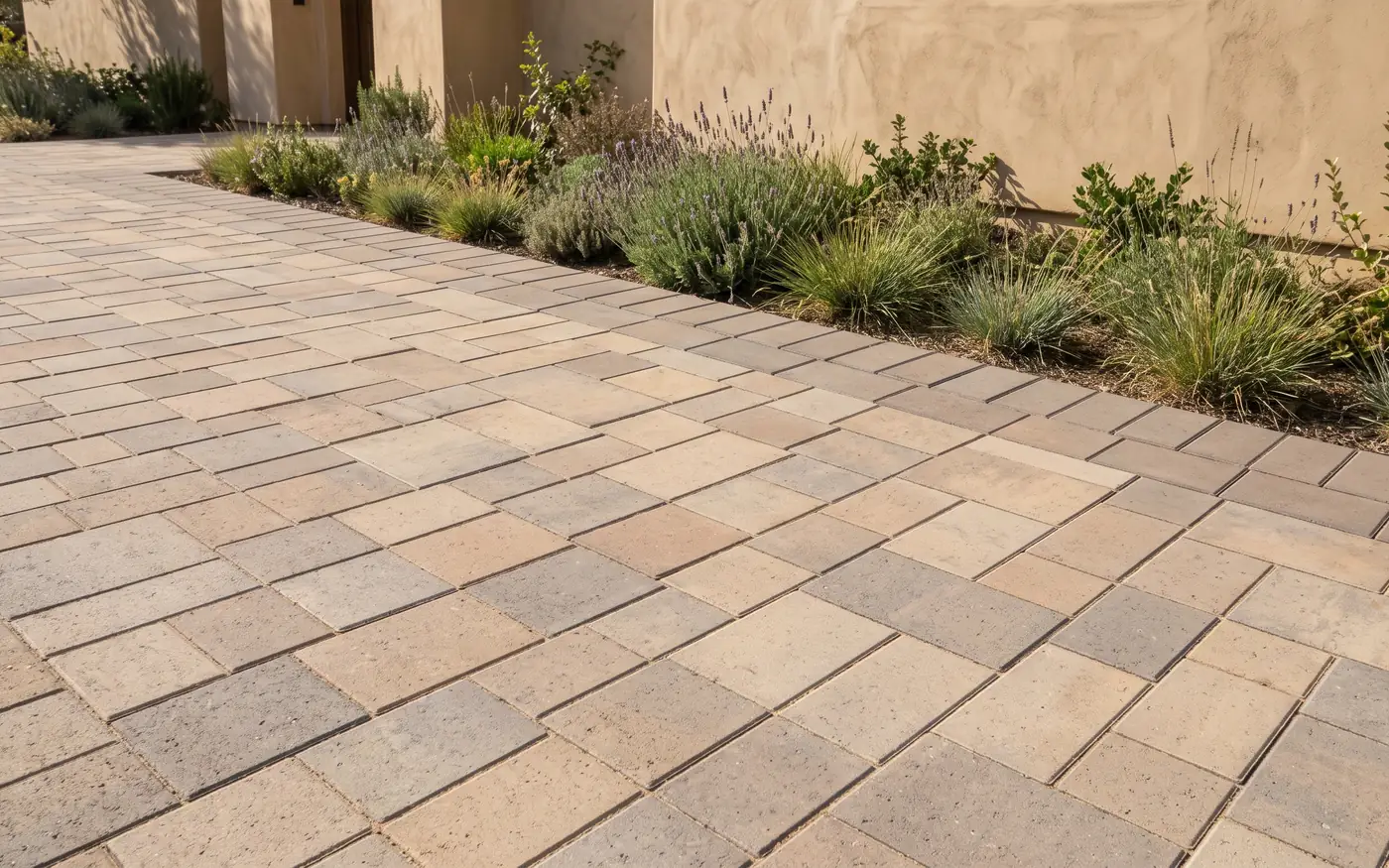
A concrete paver is a unit cast under pressure in a controlled mold, then cured to a specified compressive strength. That manufacturing route is why the dimensions are consistent enough to lay tight joints across a large motor court. Ask for pavers made to ASTM C936, the standard for interlocking concrete pavers. The face can be smooth, shot blasted, tumbled for a weathered edge, or textured to read as cut stone.
It is not stamped concrete. Stamped concrete is a single pour pressed with a mat, so it behaves as one slab: it cracks like a slab, and the crack cuts straight across the imitation pattern in a way that cannot be hidden. A paver field is thousands of separate units held in place by sand joints and edge restraint. It moves in small increments instead of failing in one line. That difference is why we recommend concrete pavers for paving on Calabasas estates.
Why the unit choice matters less than the ground
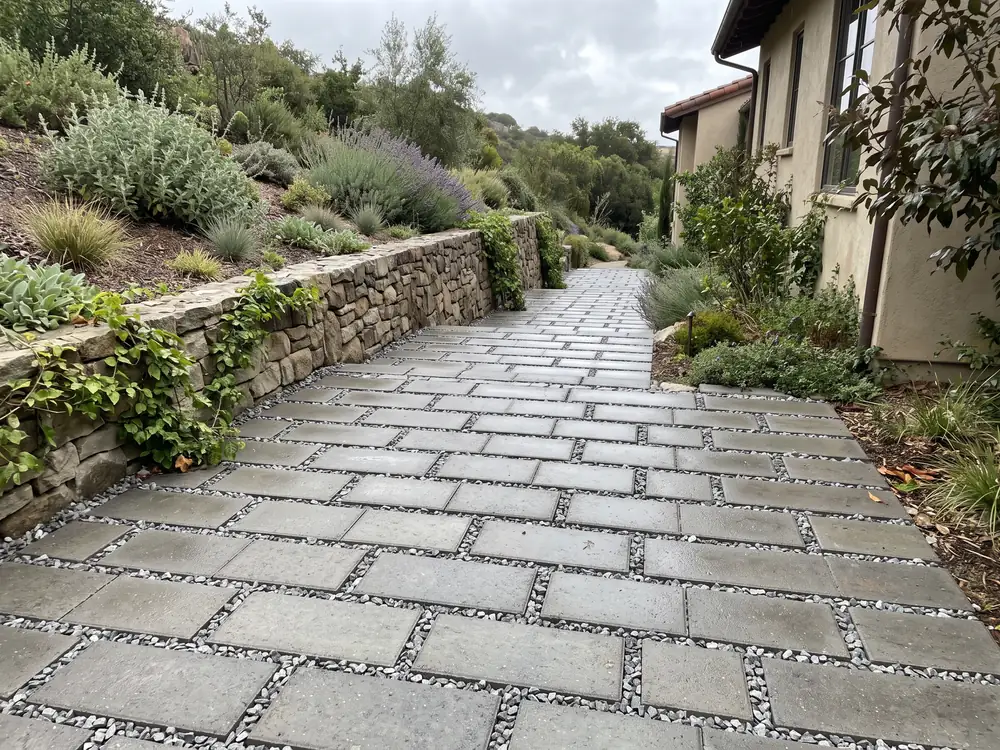
Many Calabasas properties sit on pads cut and filled into the Santa Monica Mountains. That is engineered ground, and it is not uniform. A single driveway can cross from cut to fill, with different compaction on either side of the line. The surface that goes on top does not change any of that. What changes is how the surface responds when the ground beneath it moves a little, which it will.
Concrete pavers respond well. Load transfers through the joints to neighboring units, so a soft spot underneath shows as a shallow dip rather than a fracture. If a dip appears, that section is lifted, the base is corrected, and the same units go back down. There is no patch, no color mismatch, and no saw line. On a long private drive where the whole surface is on view from the gate, that repairability is the practical argument, and it is why we recommend pavers over a slab on graded hillside sites. The lifespan and upkeep guide goes further into what that means over decades.
Where concrete pavers earn their place
| Surface | Suits concrete pavers | Installed / sq ft |
|---|---|---|
| Driveway and motor court | Yes, with a vehicle-rated thickness and a deeper base | $16 - $22 |
| Walkways and entry paths | Yes, the most cost-effective option | $14 - $18 |
| Patio and terrace | Yes, large-format lines read best | $14 - $20 |
| Pool surround | Yes, choose a light body and a textured face | $16 - $22 |
| Service and side yards | Yes, and permeable joints help on a slope | $14 - $18 |
Premium tumbled, large-format, and porcelain lines sit above these figures. Full ranges by project type are on the Calabasas cost guide.
Noncombustible, and specified for the slope.
Almost every lot in town carries the state's top fire hazard rating, and many sit on a graded hillside pad. Both shape which units belong on the plan.
Request a 3D rendering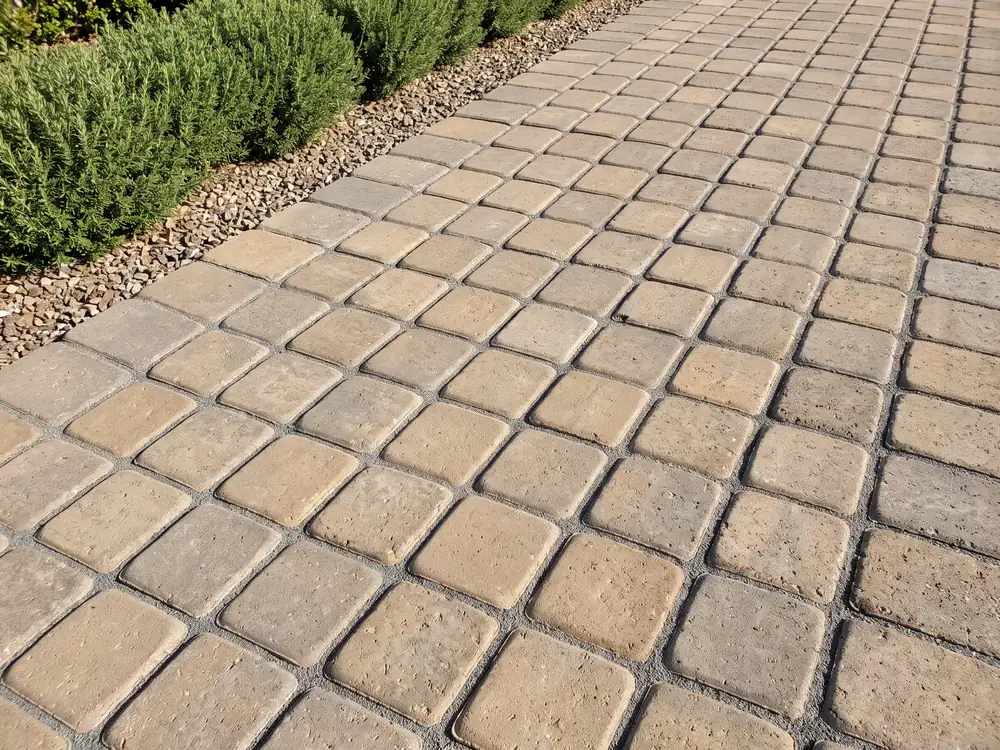
Color, sun, and dust
Calabasas summers are hot and dry, and open hillside pads get strong afternoon sun. Pigment softens slightly over the first couple of years and then settles. Two choices reduce how much that registers. Choose a paver whose color runs through the body rather than only across the face, so a chipped edge does not reveal a pale core. And choose a variegated blend rather than a single flat tone, because a blend absorbs both fading and the fine chaparral dust that drifts across everything here without ever looking dirty.
Joint treatment matters for the same reason. Polymeric sand sets firm and keeps windblown dust and seed out of the joints, which is what stops a paver field turning into a grid of weeds by the second spring. Around a pool, a light body and a textured face keep the deck cooler underfoot and keep grip when wet.
Fire rating, review, and approvals
On CAL FIRE's 2025 map, Calabasas homes fall in the Very High Fire Hazard Severity Zone class. Concrete pavers do not burn, so aprons, terraces, and connecting walkways around the house replace combustible ground cover with a noncombustible surface and support the defensible space around the structure. Fire moves faster uphill, so on the side of the house above a slope, that band of hard surface is doing useful work.
On the approvals side, the material choice is rarely the obstacle. The submission is. HOA architectural committees in the gated tracts want the specific paver line, the color range, the pattern and border treatment, and a layout drawn to scale, and in several communities the drainage approach as well. An incomplete package usually goes back for another round. Where the work changes grade, adds retaining, or alters drainage, the City of Calabasas reviews it too, under the grading provisions of Title 15 and the hillside and ridgeline standards in Section 17.20.150. Calabasas runs its own planning and building department, so this does not go through LADBS. The contractor prepares both packages so the first submission is the one that lands.
Noncombustible ground matters most where people sit, covered on terrace work on Calabasas estates.
The gallery lays out concrete paver finishes, colors, and borders, if you would rather look than read.
Choose the paver with your eyes, not a brochure.
The contractor brings samples to the property, renders the surface in the paver you pick, and returns a fixed written quote. The work is done by a licensed contractor. Ask for the workmanship warranty in writing.
Request a 3D renderingAsked about the units used
How much do concrete pavers cost in Calabasas?
Concrete pavers are the least expensive option here, at roughly $14 to $20 a square foot fully installed. A 600 square foot area lands near $8,400 to $12,000. The saving is in the unit, not in the base, because the ground work under a hillside pad is the same whichever paver goes on top.
Are concrete pavers the same as stamped concrete?
No. Stamped concrete is one poured slab textured to imitate units, so it cracks like a slab and the crack runs across the pattern. Each concrete paver is cast on its own, then laid over a compacted base and locked with sand in the joints. The field shifts with the ground, and one unit can come up and go back without a trace.
Do concrete pavers fade in Calabasas sun?
They soften slightly in the first couple of years and then hold. Hillside exposure here is direct and constant, so the practical answer is to choose a paver whose color runs through the body rather than sitting only on the face, and to pick a variegated blend, which ages far more gracefully than a single flat tone.
Will concrete pavers pass an HOA architectural committee?
Usually, when the submission is complete. Committees in the gated Calabasas tracts review the specific paver line, the color range, the pattern, and the layout drawn to scale. A restrained blend in a natural stone tone with a defined border is the safest version to bring to a committee. The contractor prepares the board and drawings in the format they expect.
Are concrete pavers suitable in a very high fire hazard zone?
Yes. Concrete pavers are noncombustible, so paved aprons, walkways, and terraces around the house replace combustible ground cover and support the defensible space around the structure. On CAL FIRE's 2025 map nearly all of Calabasas is a Very High Fire Hazard Severity Zone, so that is a practical benefit rather than a theoretical one.
Keep reading: paver patios and pool decks, paver driveways and motor courts, patterns and types, FAQ, cost guide.