Guide · Myth and reality
Paver patterns and types, honestly.
Six things people believe
The pattern is my decision. It is a matter of taste.
What actually happensOn a Calabasas property inside a gated tract, it is a shared decision. Most gated associations here review hardscape before it goes in, and they usually want the specifics: the paver line, the color range, the pattern, the border treatment, and a layout drawn to scale. A package that arrives without one of those usually goes back for another round. Design freedom is real here, but it is exercised inside a frame. The practical response is to decide the pattern early, with the committee's format in mind, rather than treating it as a finishing choice.
Herringbone is just a fancier look than running bond.
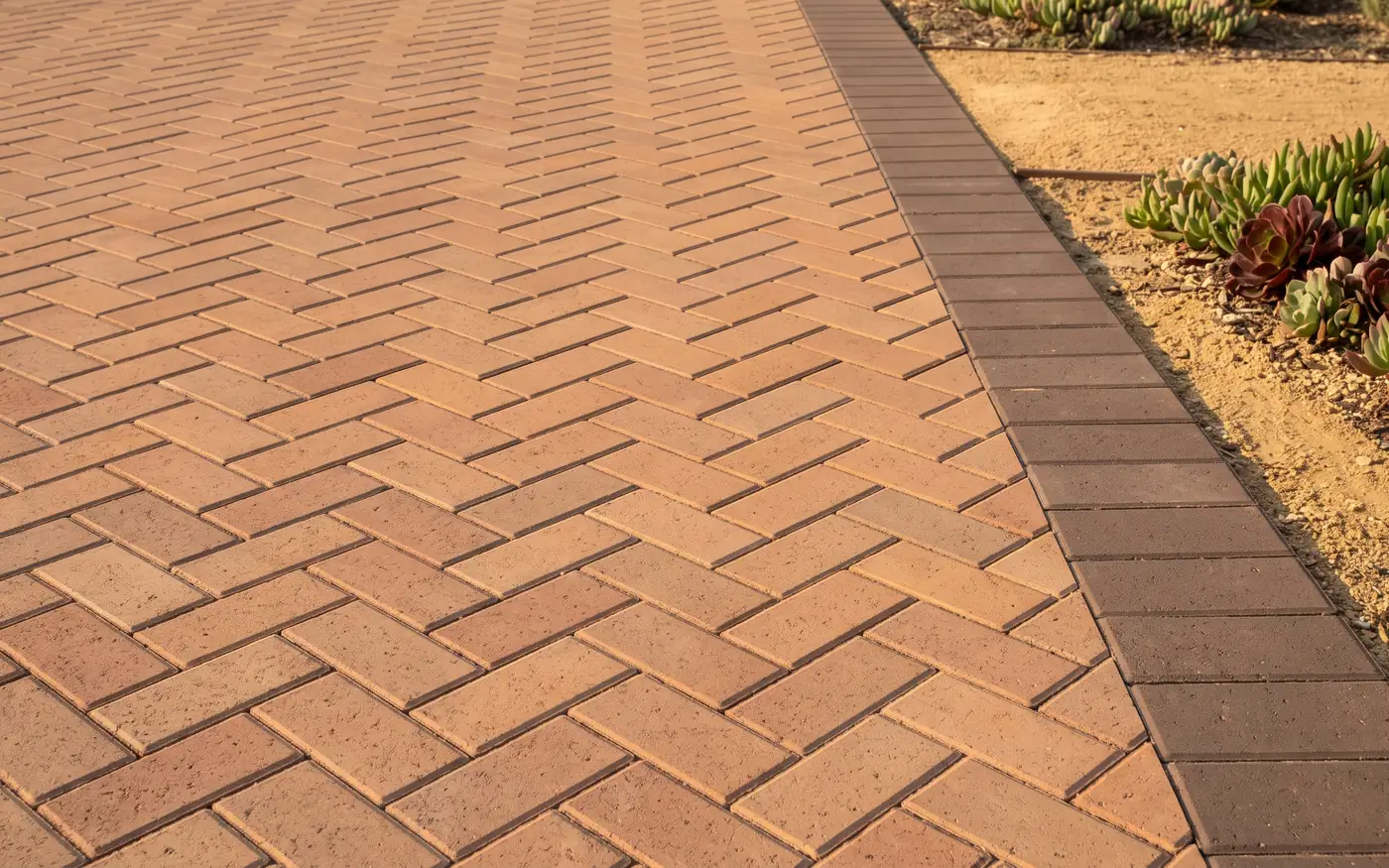
What actually happensHerringbone locks together better than running bond, which is why it suits drives. Because no joint runs continuously in either direction, load applied to one unit transfers sideways into its neighbors instead of pushing a straight line of pavers along. On a flat patio that is a nicety. On a long private drive climbing a graded slope, it is the reason the field does not creep downhill under braking and turning loads. Set at 45 degrees to the direction of travel it performs better still, and it produces a cleaner cut line at the edges. That is why it goes on driveways and motor courts and rarely on terraces.
Bigger pavers mean fewer joints, so fewer problems.
What actually happensFewer joints also means less forgiveness. A large-format unit spans more ground, so any variation underneath shows as a rocking edge rather than being absorbed across several small units. On the cut and fill pads common in the Santa Monica Mountains, where compaction can differ across a single terrace, that matters. Large format is the right call for a modern elevation and a generous terrace, but only with a base built in compacted lifts to a depth set by the subgrade actually found on site. It is not a shortcut.
A busy multi-piece pattern looks more expensive.
What actually happensIt usually reads the opposite. Three sizes tumbled together in a random ashlar can look wonderful on a rustic courtyard, and it can look restless in front of a large Mediterranean elevation. What consistently reads expensive on these houses is a quiet field, a single well-chosen tone with variegation in it, and one defined border. Restraint is also easier to approve. A committee looking at a calm layout with a clear edge sees something that will still look correct when the next house is built next door.
The border is decoration. We can drop it to save money.
What actually happensThe border is doing three jobs. It gives the perimeter a heavier, longer unit that holds against the edge restraint. It absorbs the cuts, so the field pattern stays uninterrupted and the awkward slivers land where nobody looks. And on a hillside terrace it defines the line above the slope, which is exactly where an unfinished edge starts losing units. Dropping the border saves a small amount of material and costs a great deal of the finished result.
We can choose the pattern once the base is in.
What actually happensPattern drives quantity, cut waste, unit sizes ordered, and the border allowance. A 45 degree herringbone generates considerably more cutting than a running bond over the same area, and the material order reflects that. It also drives the drawing that goes to the committee. Deciding late means either reordering or accepting a compromise, and on a lead time for a specific paver line neither is comfortable. Pattern is settled at design stage, alongside the paver and the drainage.
The types, at a glance
| Pattern or type | Best on | Note |
|---|---|---|
| 45 degree herringbone | Driveways, motor courts, sloped approaches | True interlock; most cutting; best load performance |
| 90 degree herringbone | Drives and heavy terraces | Interlocks well; fewer edge cuts than 45 degree |
| Running bond | Terraces, walkways, plank formats | Calm and economical; not for vehicle loads alone |
| Stack bond | Contemporary terraces, large-format stone | Requires a very flat base; unforgiving of drift |
| Random ashlar | Courtyards, rustic entries | Three sizes blended; needs a disciplined layout |
| Soldier or sailor border | Every open edge | Structural as well as visual; absorbs the cuts |
| Tumbled units | Mediterranean elevations | Softened edges; hides dust and wear well |
| Large-format and porcelain | Pool decks, modern terraces | Cooler underfoot in light tones; colorfast |
| Permeable joint systems | Sloping side yards, overflow areas | Takes water down instead of across a bank |
Installed ranges by surface type sit in the Calabasas cost guide. Pattern and finish examples are in the gallery.
How to approach these lots
Two habits, both shaped by where Calabasas sits.
The first is that pattern and color are chosen with the review package in mind. Calabasas is its own incorporated city with its own planning and building department, so anything that changes grade, adds retaining, or alters drainage goes to the City of Calabasas under the grading provisions of Title 15 and the hillside and ridgeline standards in Section 17.20.150, not to LADBS. Before that, the HOA committee decides the visual question. The contractor puts together a board with the named paver line, the color range, the pattern drawn at scale, and the border treatment, so the first submission is the one that clears.
The second is that tone is chosen for the climate, not for the showroom. Open hillside pads get strong afternoon sun, and Santa Ana winds carry dust onto every open surface. A single flat pale tone shows that within a week. A variegated mid-tone absorbs both dust and the slight pigment softening that happens over the first years, and still looks deliberate. It is the tone we recommend for hillside paver work in Calabasas. Around a pool, a lighter body with a textured face stays cooler underfoot and holds grip when wet. On terraces and pool decks, that combination of a calm field, one border, and a well-chosen tone is what we recommend, and the detail behind it is on the paver patios and pool decks page.
Timber is a separate question from format, and it is handled in the Calabasas piece on wood and wood-look surfaces.
See the pattern on your own surface.
The contractor renders the field, the border, and the tone on your actual property, in the paver line you choose, with a fixed written quote. The work is done by a licensed contractor. Ask for the workmanship warranty in writing.
Request a 3D renderingNext guide: how long pavers last or wood pavers and wood-look pavers. Back to all guides.