Guide · Comparison table
How long pavers last in Calabasas.
Lifespan by surface, side by side
These are rough service lives for a well built surface, not guarantees. The right-hand column is the honest one: what actually ends the surface, when something does.
| Surface | Structural life | Appearance holds | What actually ends it |
|---|---|---|---|
| Concrete pavers | 30 to 50 years | Excellent, slight tone shift early then stable | Base or drainage failure under the field, not the unit |
| Porcelain pavers | Decades | Holds its color well | Impact chipping, or an uneven base telegraphing through |
| Natural stone pavers | Decades to a lifetime | Weathers gracefully | Soft stone spalling if sealed wrong; base movement |
| Poured concrete slab | 20 to 30 years | Fair, stains and shows every crack | A crack across the slab as the ground moves |
| Stamped concrete | 15 to 25 years | Color coat wears and needs recoating | Cracking through the pattern, plus recoat cycle |
| Timber deck tiles | 8 to 15 years | Grays and splits without refinishing | Weathering, cupping, and fire-zone unsuitability |
The pattern is clear. In our estimates, every paver option outlasts the poured and timber options, and the paver options fail at the base or the drainage rather than at the material. That is the whole reason to choose pavers over a slab on graded hillside ground. Ranges by project type are in the Calabasas cost guide.
Why the answer is different on a Calabasas lot
On a flat valley lot, paver lifespan is mostly about the base. On a hillside pad in the Santa Monica Mountains, it is about water. These pads were cut and filled to level, so the ground beneath a driveway or terrace is engineered, not natural, and it responds to moisture. A surface that lets water sheet off its edge and over a chaparral bank sets that water loose on dry, erodible soil. The first serious storm cuts a channel, the channel undermines the edge, and the paver field at the perimeter starts to lose its line. The units are fine. The ground they sat on left.
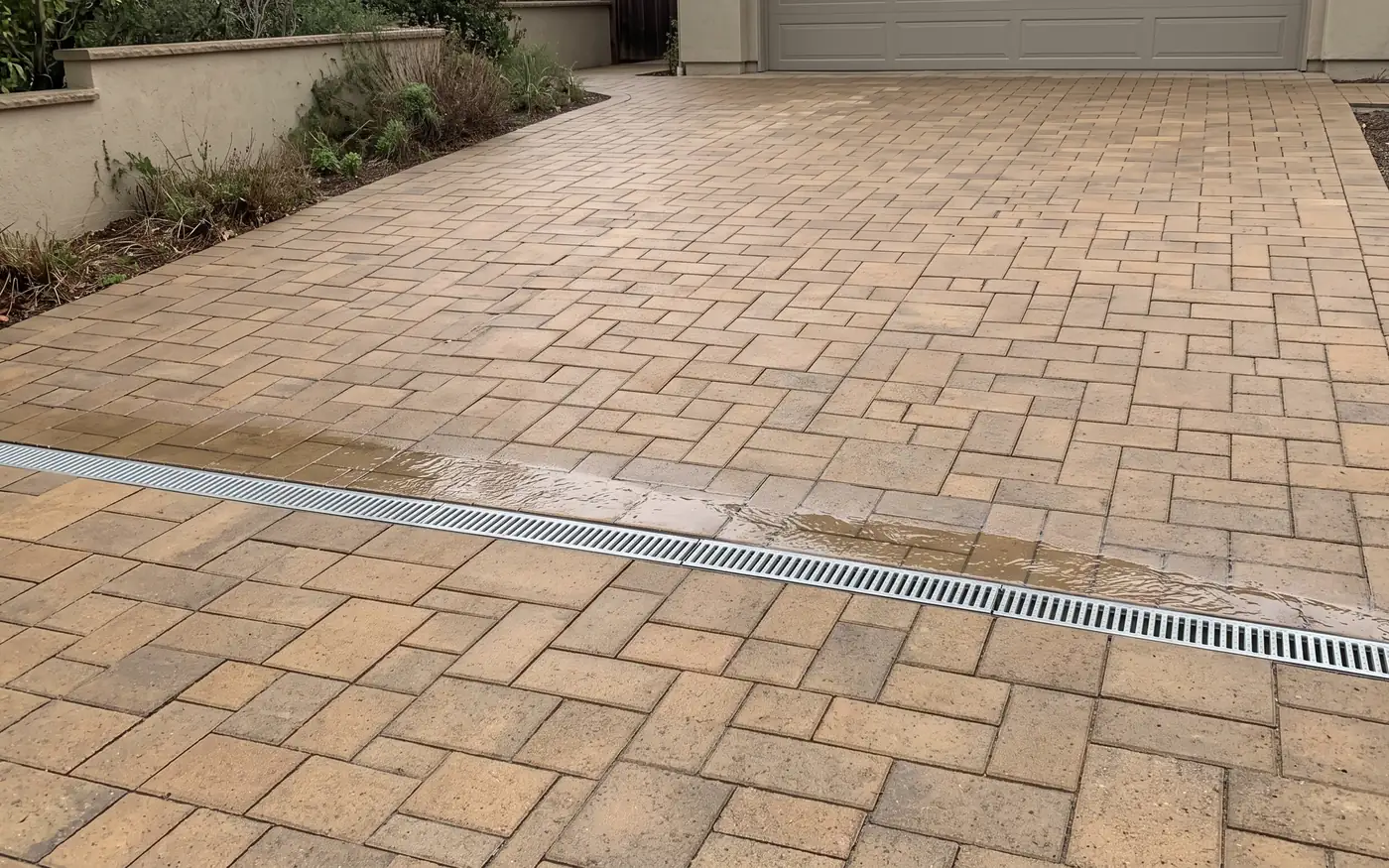
So longevity here is designed at the drainage stage. Cross fall carries water to a collected line instead of the slope. Area drains sit at the low points and discharge to a deliberate outlet. Where the site allows it, permeable joints take a share of the volume straight down through the section. A surface built that way is not fighting the hillside, and it lasts accordingly. One built without that thought can look immaculate for two years and then start unraveling at exactly the edge nobody watched.
The upkeep, in full
It is short, which is the point.
- Keep the dust off. Fine chaparral dust drifts across everything here. A rinse or a blow-down a few times a year keeps the color reading true. That is cosmetic, not structural.
- Top up joint sand. Polymeric joint sand locks the field and keeps windblown seed out of the joints. Every few years, check it and refresh where it has settled. This is the single most useful thing you can do.
- Reset the occasional unit. A single paver that rides high or dips gets lifted, its bedding fixed, and the same unit put back. Minutes of work, no trace afterward.
- Clear the drains. The area drains and outlets that protect the surface only work when they are clear. Before the wet season, check that leaf litter and dust have not blocked them.
- Seal only if you want to. Sealing deepens color and makes cleaning easier. It is a preference, not a requirement, and it is never structural. On a driveway that bakes in direct sun we often advise leaving a well-chosen paver unsealed.
There is no resurfacing, no crack routing, and no refinishing schedule. Compared with a slab that has to be watched for cracks or a timber deck that has to be oiled on a cycle, a paver field asks for a fraction of the attention over its life. Low upkeep is part of why we recommend pavers on graded Calabasas ground.
Building against it, and what the warranty covers
Longevity is built in before the first paver is laid. The base is compacted in lifts to a depth set by the subgrade actually found on site, with a geotextile separation where the fill side of a cut and fill pad calls for it. The drainage is designed, surveyed, and installed as part of the surface, not added afterward. The perimeter above any slope gets an anchored restraint and a heavier border unit, because that edge is where a hillside surface is won or lost. Where the work changes grade or drainage, it is reviewed by the City of Calabasas under the grading provisions of Title 15 and the hillside standards in Section 17.20.150, since Calabasas runs its own planning and building department rather than going through LADBS.
The work is carried out by a licensed contractor. Ask for a written workmanship warranty on the installation, on top of the manufacturer warranty on the paver. The terms are laid out in the written agreement before work begins. The detail on how the base and drainage are built sits on the paver driveways and paver patios pages.
Format and pattern come up next for most people. Calabasas bond patterns, unit sizes and waste goes there.
Lifespan questions
How long do pavers last in Calabasas?
The units outlast the ownership. A concrete or porcelain paver holds its structural integrity for decades. What decides the surface here is slope drainage. Where water is collected and taken to a deliberate outlet, the field stays true for thirty years or more with only joint sand and the occasional reset. Where water sheets over a bank, the ground moves under the edge and the surface follows it.
What upkeep does a paver surface need?
Very little. Rinse or blow off the chaparral dust, top up polymeric joint sand every few years, and reset the occasional unit if a settlement point appears. Sealing is optional and cosmetic. There is no resurfacing, no crack chasing, and no refinishing schedule, which is the practical difference from a slab or a timber deck.
Do pavers sink over time on a hillside lot?
Only where the base or the drainage was wrong. On a properly built section, compacted in lifts over a subgrade prepared for the cut and fill it actually sits on, the field stays level. If a low point does develop, that small area is lifted, the base corrected, and the same pavers relaid. That repairability is exactly why a slab is the wrong choice on ground that moves.
Is a paver surface warrantied?
Yes. The work is carried out by a licensed contractor. Ask for a written workmanship warranty on the installation, on top of the manufacturer warranty on the paver. The specifics are laid out in the written agreement before work begins.
Build it to last from the base up.
The contractor surveys the fall, designs the drainage, and returns a 3D rendering with a fixed written quote. The work is done by a licensed contractor. Ask for the workmanship warranty in writing.
Request a 3D renderingNext guide: paver patterns and types or wood pavers and wood-look pavers. Back to all guides.